Categories
Conferences/Events Ed Reform/Policy Tech in the classroom

Teacher Tech Talk

During my exploration deeper into the world of edtech, meeting with countless entrepreneurs & investors and attending numerous conferences & events, I feel a very important perspective is missing from this growing movement… the voice and participation of educators. Can we really redesign and distribute new innovations in teaching and learning without active involvement from the teacher community? I’ve been to several edtech meetups, Startup Weekend EDU events and conferences and it’s rare to find attendees that are actually current teachers, working directly with students and trying out the new tools that seem to pop up weekly.

So, what can we do about that? Last night I hosted the first Teacher Tech Talk event to help identify and build a community of educators that are interested in playing a more vocal and active role  in this growing edtech movement. It’s been hard to miss all the buzz around the ‘edtech’ world lately, however, people who have been thinking about ed reform for a while recognize that technology is merely a tool and the larger disruptions and improvements to current teaching and learning practices depend on when/how those tools are used, which is  largely driven by educators.
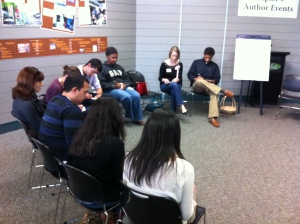
My goal for this community is to collectively figure out how best to bridge the educator and education startup worlds. How can we get more perspective from what is happening in classrooms and schools into the product development process of startups, rather than when it’s time to find beta testers or product evangelists? The group consisted of current and former educators, entrepreneurs, school/district tech leads and even an investor. The diversity of perspectives lead to a very insightful discussion session, and as this community grows I imagine it will attract more entrepreneurs and investors, however, I’m extremely focused on keeping the content and conversation centered on educators.

After some networking, we settled into a brainstorming and discussion session around what the educators think would make their teaching lives easier. The responses ranged from predictable need for more time, access to devices, actionable data to more collective impact approaches, engaging parents, inter/intra district collaboration and thinking how to bring more relevancy and real-world application to the current standards-based curriculum. Greg Klein was our first guest speaker, invited to share his perspective as a former principal in Oakland and current teacher, leading the blended learning initiatives at Downtown College Prep. He shared an in-depth look into the tools (Khan Academy, Manga High and long list of others) and process he’s piloting at DCP and stay tuned for a follow-up post that goes into more detail. Brett Kopf, co-founder of Remind101, then shared his experience incubating his startup through Imaginek12 and speaking with hundreds of teachers before starting to build his product that aims to power communication between teachers, parents and students.

This pilot event was a success and surfaced some extremely useful feedback on how to grow and shape this community going forward. Look out for an invite to next month’s event and if you’re interested in getting involved in anyway, let me know. As with most startups, I’m figuring this out as I go and can use all the feedback I can get!

Categories
Blended Learning

Blended Learning in the Bay

Last Friday, KQED Forum discussed some of the blended learning programs in the Bay Area and in CA more broadly. While the conversation focused heavily on Rocketship‘s current model and ambitious growth plans, Tina Barseghian, editor of MindShift, also shares some feedback from students, teachers and other districts.  It’s a quick 30min discussion and worth it if you’re curious to hear current sentiment around blended/hybrid learning and some of the arguments for/against the role of teachers in a technology and data rich teaching environment.

Categories
Learning to Code

My so-coding life

Just over the past few weeks I’ve read about several initiatives to help teach anyone basic coding skills.  As I work on my second lesson from Code Year (Week 2: functions in javascript), my mind wanders back to the few CS classes I took in undergrad almost 10 years ago and I’m seriously impressed by how much easier and accessible this content is for anyone who wants to learn to code. (The desire to learn is a big part and I’ll come back to this.) In just about a week, over 350,000 people signed up for the CodeYear program, designed by the Codecademy team (the darling of the most recent YC batch) that raised $2.5M just a couple months after launching last August. (Those growth numbers are amazing and Fred Wilson does a great job outlining some of the factors that contributed to those sign-ups.)

Adding to that buzz, Codecademy announced an abbreviated version of Code Year, CodeSummer+, in partnership with the White House and their Summer Jobs+ Program to “ provide pathways to employment for low-income and disconnected youth in the summer of 2012.” It is wonderful to see the various startups and government officials that are coming together to build off this momentum and create resources & programs that are needed in schools & communities across the country. However, I think the more important points of this announcement are the offline meetups and Q&A forums. While delivering content online is efficient, scalable and allows for self-paced learning, learning is inherently social so these 2 aspects of their program are crucial to reaching the goal of actually teaching people to code. Combining their online content with offline interactions to create a blended learning model is a smart approach that other hot digital learning startups, such as Khan Academy, are developing as well to reach key learning goals.

And speaking of learning goals, I’m curious to see some of the assessments that go along with Code Year to help confirm that I am, in fact, becoming a hacker. (Of course I’m also relying on several other online resources as well as direct instruction from my sometimes not-so-patient hacker husband.)

Back to an earlier point…One of the key drivers to learning anything is interest, so in order for these types of programs to be successful the first step is actually to foster the desire for people to want to code. Coming from the Silicon Valley, it’s fairly obvious to many of us, but convincing a middle/high school student from another environment is slightly more challenging. That is what excites me most about The Academy for Software Engineering, NY’s first public high school that will actually train kids to develop software. Beyond being open to any student that is interested and focusing on diversity in STEM fields, the school is focusing on 9th graders and helping plant the seed of why coding is an important and necessary skill. I believe igniting that interest in 14 year olds is what will truly lead to a world of coders.

And in contributing to that larger teach-the-world-to-code vision and my own personal goals, I should get back to my lesson.

Categories
Blended Learning

Khan Academy welcomes Vi Hart

Vi Hart, newest faculty member of Khan Academy, brings some whimsy (and elephants) to math education. Enjoy!

Categories
Blended Learning

SF Flex Academy

A friend of mine recently joined the team at SF Flex Academy, one of a handful of truly blended learning schools in the Bay Area. What I love most about this video is the diversity of the students and how they all have found a passion for learning and building community in this school environment. I hope to check out their blended learning lab very soon. SF Flex is a free, public (charter) high school that is currently accepting applications and looking for a history teacher, so please help spread the word.

Categories
Blended Learning

Blended Learning Lab- Downtown College Prep (Alum Rock)

Khan Academy exercise dashboard

Red and green cup system

Blended Learning Lab- Downtown College Prep (Alum Rock)

Categories
Blended Learning

Blended Learning- In Real Life

I’ve watched the videos, read the blogs and spent a full day in SF last month at a conference that championed the future of blended learning…and today I got to see it in real life (IRL.)

A friend of mine, Justin Su, invited me to check out the learning lab that he helped set up at Downtown College Prep(DCP) who just launched their Alum Rock campus with 180 6th and 7th graders this fall. DCP is one of the few schools in the Bay Area that has implemented a truly blended learning approach where each student spends 90 minutes a day in the learning lab with Greg Klein, a certified teacher and self-proclaimed tech geek, who is clearly optimistic about the potential for this model. The lab contains 60 computers, configured with help from a Cisco volunteer, that provide a variety of offerings for the students, including; Khan Academy (math), TeenBiz/Achieve3000 (ELA), MangaHigh (math), ALEKS (math) and GoalBook. Klein utilizes Edmodo as a tool to communicate and collaborate with students to guide their learning by creating individualized playlists for different groups of students.

A couple of the students walked me through their daily math routine. Choose a station->log into Khan Academy (via Google account)-> load Edmodo to see their playlists-> begin working. I quickly learned that many of the students skip the videos and jump right into the exercises, applying lessons learned from their math teacher, in real life, to figure out the right answer. If they get stuck, they request a hint through the system, select an answer and move on. As a fan of Sal Khan’s videos, I couldn’t help but feel the kids were missing out, but having worked with middle schoolers for years I understand their perspective— “I get it. I know the answer. Let’s move on.” And Greg gets it too, sharing his view that the goal is not for the kids to watch the videos but rather for them to understand the content and be engaged in their learning process. The beauty of this just-in-time content delivery, where the videos are there for review if/when students need them, is the backbone of a self-paced learning environment. These content tools blended together with guidance from educators like Greg, as well as the ELA and Math teachers IRL, create an effective and interactive learning environment for these students.

Greg’s simple ‘red cup/green cup’ system builds on this view, where once a student has completed their assigned work they are given a green cup (can you see them in the picture?) which means they are free to work on whatever area they choose. This simple system empowers students to take ownership over their time and learning progress, which is the hallmark of a successful blended learning model.  Tools such as Goalbook further enhance this process, allowing students to create personal learning plans where they can write their own goals and easily track/share progress with teachers and parents.

I’m very optimistic about blended learning and feel that when implemented effectively, it can really improve the learning experience for students and teaching experience for educators. I’m grateful for the time I got to spend observing blended learning IRL and my experience reminded me that while online content is great, you still need real life interaction to solidify and reinforce your knowledge and beliefs. Next up on my list is to check out the learning lab at Rocketship.

Categories
Blended Learning Conferences/Events

Technology and student-centric learning

Between the Philanthropy Roundtable event on Wednesday and the Startup Weekend EDU at Grockit on Sunday I’ve seen first hand the energy and momentum that is building in this space.

The Roundtable event was focused on how technology, and specifically blended learning, can be used to create student-centric learning environments. It was fantastic to see practitioners, politicians and philanthropists all coming together to rethink the purpose of schools and how students actually learn. One of the areas most interesting to me and my current work is thinking about how blended learning environments can create time/space for more project-based learning (PBL) activities. Explicitly giving kids more opportunities to work with their hands and each other.

The breakout sessions highlighted several examples of charter schools successfully applying a blended learning approach: Carpe Diem (Yuma, AZ), Rocketship (San Jose), Kipp LA Empower Academy and Summit Public Schools (Redwood City.) Beyond creative uses of technology it was great to see all of these schools focusing on building a culture of achievement and really engaging students in their own learning and that of their peers. This cultural shift is the real key to improving education outcomes for all kids.


During lunch, Jeb Bush shared his perspective on what policy makers and public/district officials can do to foster innovations in the education space. I was pleasantly surprised by the diversity of solutions that he supported and his message that the ultimate goal should be “a customized learning system that values student outcomes above all else.” He went on to say that we should not over-regulate the space but rather treat it as other industries where we accept the risk of a few bad actors banking on the larger reward of “explosions in innovation.”

The afternoon sessions continued with conversations around what policy makers can do to create an environment that encourages high quality digital learning and how traditional schools can incorporate some successful blended learning models.

The event culminated with New Schools Venture Fund unveiling their Edtech Market Map. I think it’s a great start and we need more robust tools to be able to identify and follow key trends in the edtech space. They presented it as v1 and I’m looking forward to seeing what functionalities are added over time (tagging? following?) Take some time to play around and let me know what you think!

Blended learning is definitely hot topic in education right now and if you want to learn more, check out these additional resources.

  • The Rise of K-12 Blended Learning – The seminal piece on blended learning school models, this short paper explains how each model operates and outlines several
  • How Khan Academy is Changing the Rules of Education – This Wired Magazine article from July 2011 explains the on-the-ground implications of online and blended learning, including how technology impacts students’ and teachers’ daily schedules.
  • Is there a K-12 Online Learning Bubble? – Written by Michael Horn of the Innosight Institute, this article outlines a number of the issues with low-quality digital learning and the need for policy that rewards student performance outcomes.
Categories
Blended Learning

What is Blended Learning?

Link: What is Blended Learning?

Check out these 3 short videos from Education Elements that provide an overview of blended learning.