
Khan Academy exercise dashboard

Red and green cup system
Blended Learning Lab- Downtown College Prep (Alum Rock)
Khan Academy exercise dashboard
Red and green cup system
Blended Learning Lab- Downtown College Prep (Alum Rock)
I’ve watched the videos, read the blogs and spent a full day in SF last month at a conference that championed the future of blended learning…and today I got to see it in real life (IRL.)
A friend of mine, Justin Su, invited me to check out the learning lab that he helped set up at Downtown College Prep(DCP) who just launched their Alum Rock campus with 180 6th and 7th graders this fall. DCP is one of the few schools in the Bay Area that has implemented a truly blended learning approach where each student spends 90 minutes a day in the learning lab with Greg Klein, a certified teacher and self-proclaimed tech geek, who is clearly optimistic about the potential for this model. The lab contains 60 computers, configured with help from a Cisco volunteer, that provide a variety of offerings for the students, including; Khan Academy (math), TeenBiz/Achieve3000 (ELA), MangaHigh (math), ALEKS (math) and GoalBook. Klein utilizes Edmodo as a tool to communicate and collaborate with students to guide their learning by creating individualized playlists for different groups of students.
A couple of the students walked me through their daily math routine. Choose a station->log into Khan Academy (via Google account)-> load Edmodo to see their playlists-> begin working. I quickly learned that many of the students skip the videos and jump right into the exercises, applying lessons learned from their math teacher, in real life, to figure out the right answer. If they get stuck, they request a hint through the system, select an answer and move on. As a fan of Sal Khan’s videos, I couldn’t help but feel the kids were missing out, but having worked with middle schoolers for years I understand their perspective— “I get it. I know the answer. Let’s move on.” And Greg gets it too, sharing his view that the goal is not for the kids to watch the videos but rather for them to understand the content and be engaged in their learning process. The beauty of this just-in-time content delivery, where the videos are there for review if/when students need them, is the backbone of a self-paced learning environment. These content tools blended together with guidance from educators like Greg, as well as the ELA and Math teachers IRL, create an effective and interactive learning environment for these students.
Greg’s simple ‘red cup/green cup’ system builds on this view, where once a student has completed their assigned work they are given a green cup (can you see them in the picture?) which means they are free to work on whatever area they choose. This simple system empowers students to take ownership over their time and learning progress, which is the hallmark of a successful blended learning model. Tools such as Goalbook further enhance this process, allowing students to create personal learning plans where they can write their own goals and easily track/share progress with teachers and parents.
I’m very optimistic about blended learning and feel that when implemented effectively, it can really improve the learning experience for students and teaching experience for educators. I’m grateful for the time I got to spend observing blended learning IRL and my experience reminded me that while online content is great, you still need real life interaction to solidify and reinforce your knowledge and beliefs. Next up on my list is to check out the learning lab at Rocketship.
Short and inspiring video from Tina Seelig, Executive Director of the Stanford Technology Ventures Program (STVP), sharing a story about her classroom project on entrepreneurship. Great lesson for all entrepreneurs to think about how you’re framing the problem/pain you’re trying to address and the resources you have available to help you achieve your goals. I especially like the point that seed money itself can be limiting and that people often undervalue their own skills.
Last night I attended a wonderful event supporting the Technovation Challenge, an inspiring program started by a friend of mine, Anu Tewary, to encourage high school girls to pursue STEM-related careers. This video captures the essence of the program and illustrates how participants learn about product development, design-thinking and programming through building Android Apps, such as World MPowered. The event, hosted at Andreessen Horowitz, centered around a panel of several high profile women in technology including Marissa Mayer, Padmasree Warrior, Freada Kapor Klein and Angela Benton. While the speakers were notable, what was even more impressive were the people in the standing-room-only crowd which included bright female entrepreneurs, like Leah Busque from Task Rabbit and Alexis Ringwald.
The main goal of the evening was to share inspiring stories of women in technology and to encourage the attendees to pay-it-forward by mentoring girls through the Technovation Challenge. Anyone can get involved by helping spread the word or signing up to be a mentor. The success of programs such as this, and others offered through Iridescent, is vital to building a diverse pipeline of women entrepreneurs and developers, and showing girls that it’s actually cool to be a geek.
“Revolutionary Technologies and the Future of Education”- panel from 20th Anniversary TFA Summit (Feb 2011)
It’s a bit long but the panelist share some unique insights on how their schools are integrating technology to create personalized learning environments for students, especially at Rocketship and School of One.
Great visualization of how we need to shift our thinking on what is the purpose of school and education from the great Sir Ken Robinson.
Design Thinking @ The Nueva School
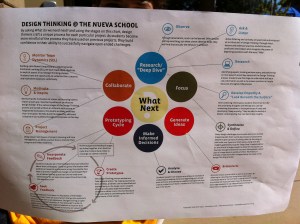
Last Friday I attended the Innovative Learning Conference, hosted by the Nueva School every other year, and the whole experience just blew me away. The school itself is a beautiful collection of older and newer buildings sprinkled on lush hill side in Hillsborough. Choosing the highlight of the day was almost as difficult as choosing which individual sessions to attend. I started off with listening to Dr. Dean Ornish share his thoughts on wellness and the motivation needed to make sustainable lifestyle changes. From there I moved on to Prasad Ram’s presentation of Gooru Learning and his vision for making a tool for teachers to easily incorporate online resources into their lesson plans and share them with others. The day continued to get better as I had the pleasure of meeting Sal Khan and hearing him share a more intimate version of how the Khan Academy sprouted from his first videos into the rapidly growing library it is today. I ended the day with a brief guided meditation from Shauna Shapiro and then a conversation with Neeru Khosla on how CK-12 has quietly and consistently been working to disrupt the textbook industry. And these were just the speakers that I got a chance to see!
However, my favorite part of the day was learning about the iLab, which is a product of collaboration between Nueva and The Institute of Design at Stanford, and very closely resembles some d.school workspaces. Through sessions with Kim Saxe and Susie Wise I learned how kids as young as 5 are introduced to the basics of design-thinking, by brainstorming needs statements and then applying the 3e’s: Empathy, Experiment, Environment to come up with solutions that address those needs. The open space itself as well as the practices of the iLab illustrate the shift from STEM->STEAM, bringing the much-needed focus on arts and creative thinking back into the classroom.
One of the most important messages (especially to the educators in the audience) is that these practices don’t require significant resources but rather a shift in how problems and the brainstorming processes are presented to kids. Grab some post-its, put wheels on the bottom of a few Ikea desks and you are ready to build a design-thinking workshop at any school! You can read more about explicitly teaching design-thinking to students (and teachers through Stanford’s K-12 Lab) in this recent WSJ piece on David Kelly, founder of IDEO.
Susie shared her experiences in creating a ‘culture of design’ and how they are applying learnings from the iLab to the Urban Montessori School they are establishing in Oakland (Fall 2012,) of which she is a founding team member. I’d love to visit this school soon and am sure I won’t be able to wait 2 years for the next ILC before visiting Nueva again too!
Education 2.0 Roundtable: Redefining K-12 education in America, before it redefines us
Khan Academy launched a partnership today with SmartHistory which not only expands their content library but introduces new instructional voices and perspectives to the popular site. The new Art History section contains 100+ videos discussing a variety of historic pieces from Ancient to Modern times and begins with this message: “Spontaneous conversations about works of art where the speakers are not afraid to disagree with each other or art history orthodoxy. Videos are made by Dr. Beth Harris and Dr. Steven Zucker along with other contributors.”
Clicking on one of the videos directs you to the SmartHistory site which is visibly labeled as ‘presented by Khan Academy.’ I think this partnership is a great step in the right direction to increase the content offering and perspectives that are guiding and ‘instructing’ viewers on this incredibly popular site, which has tripled its unique users to 3.5 million over the past year. I was especially intrigued to see that some of the ‘other contributors’ include Second Life correspondents, such as the two avatars who guide us through this recreation of Michelangelo’s Ceiling of the Sistine Chapel, providing historical and physical context in their explanation.
I’m thrilled to see art history content highlighted in this way and am looking forward to what future partnerships will bring to the Khan Academy.
You can watch Sal Khan sharing this announcement at the Web 2.0 Conference here.
 edcrunch