Categories
Entrepreneurship Learning to Code

Cultivating Entrepreneurs of the Future

I was honored to be a judge at the Technovation Pitch Competition today at Microsoft and was truly blown away by how much the program has grown over the past 3 years. Iridescent founder, Tara Chklovski, kicked off the event by sharing some startling statistics about how 6th grade girls actually score better in STEM content areas but somehow once we get to higher ed communities in a room of ~30 engineering students, only 3 will be girls. I wish that every person who has ever talked about the lack of diversity in the startup community would have been in the room today, not only to hear these stats, but to see a program like the Technovation Challenge that is determined to change the ratio.
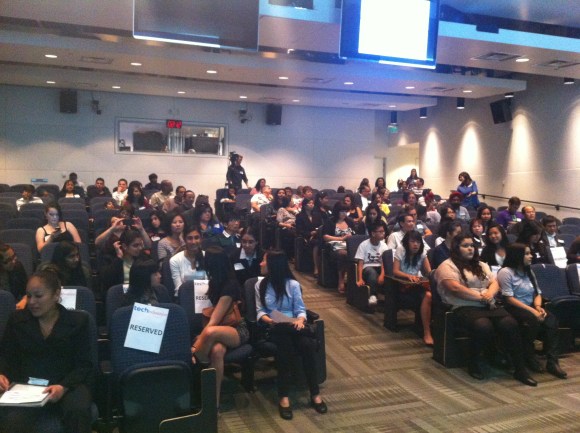
If only all Demo Days embodied this level of energy and authentic enthusiasm. 10 teams had 4 min each to pitch their Android App and then respond to questions from the judges. The ideas ranged from medical/healthcare apps that allow you to easily share your general medical history to food discovery apps for people with allergies or dietary restrictions (vegans) and games that teach marine biology in a fun and engaging way. The winning team from our session was an app designed to reduce teenage pregnancy and STDs by providing preventative care information in a format that is appealing and compelling for high school students.  The pitches were great, however, what was most impressive was the demonstration of what the girls had learned about what it really means to make something out of nothing. During the poster session I spoke with several of the teams who shared their experiences with customer development, co-founder disagreements, sizing the market, brainstorming distribution strategies, outlining business models and perfecting your pitch. These are the exact same topics that I discuss with startups that I work with in various incubator programs in Silicon Valley and it’s inspiring to see high schools girls learning these processes and techniques that they will hopefully carry with them as they continue their education and professional careers. This is what authentic STEM education looks like. This is what teaching entrepreneurship really means.

Towards the end of the event I was asked what I’d like to see come out of this type of program over the next several years. Ideally, if we say we want to educate our children to be the innovators of the future then I strongly believe this type of program needs to be integrated into the K12 curriculum. Shouldn’t all students have an opportunity to gain these necessary skills during the traditional school day?

The winning teams from today and the other regional challenges will come together at Intel in Santa Clara next Thurs, May 3rd for the National Pitch Competition. Tickets are free so if you’re available and are interested in seeing what empowering young girls to develop an authentic desire for coding and entrepreneurship looks like, I highly recommend you attend. Kudos to the entire Iridescent team for a fabulous event today and for empowering high school girls all over the country to design their futures.


Categories
Entrepreneurship Investing in Education

Teachers as Innovators

I occasionally have moments on my morning drive where I’m so captivated by the conversation on NPR that I spend a few extra minutes just sitting and listening. This happened to me on Tuesday while listening to the Forum segment with The Economist’s Vijay Vaitheeswaran talking about his latest book, “Need, Speed, and Greed.” His broader message is that risk-taking innovation is the only way for companies and entrepreneurs to survive in a disruptive era of globalization and I was particularly drawn into his points on how education plays such a vital role in innovation. Vijay defines innovation as ‘fresh thinking that adds/creates value’ and I really appreciate his emphasis on how innovation is not always related to or dependent on technology.  In applying this to education, this immediately made me think about a recent EdWeek article highlighting a study that shows ‘Teachers Can Influence Colleagues, Change Schools.’ If more teachers see themselves as the innovators, tasked with the challenge of determining how/when to utilize various edtech tools (which is far more difficult than just creating them), that will drive significant improvements in teaching and learning. My favorite message from that piece is that  “Educators must consider each other the most valuable resource in a system, to be developed and supported with leadership, structures, tools, and processes for promoting continual professional learning.” I believe that the value created from focusing on teachers as innovators and constant learners themselves is the true revolution that schools need in order to improve student outcomes.

He went on to stress the importance of investing in education, which is one of the main drivers of innovation and that recent cuts to higher ed, especially to the UC system, are fundamentally wrong as we are cutting future productivity gains. Vijay’s views on purpose really resonated with me and were the main reason I came back and listened to the rest of the segment. He shares that in an ideas based economy, what truly motivates people is “purpose,  a sense of community, autonomy, mastery, independence, being good at what you do and connecting with something bigger than yourself.” If you know me or have read previous posts, you’ll know how much I whole-heartedly agree with this sentiment.

I find his optimistic perspective extremely refreshing in a conversation around poverty alleviation and education that is often portrayed as in crisis-mode. He asserts that change is possible and disruptive change is coming (with a nice shout-out to Khan Academy and Acumen Fund.) I agree and am enthusiastically hopeful to see what we as a society can create when we focus on greed for good.

Categories
Entrepreneurship

The Long Tail of Edtech

In case you missed it, last weekend education technology enthusiast, Steve Hargadon, applied the long-tail framework to explain some of the key trends we are seeing in the edtech space right now in his post, A “Tail” of Two Edtech Agendas. I think this is a very helpful way to understand why certain startups are capturing much of the capital and media attention right now, even though they may not be poised to deliver the deeper disruption that many of us are hopeful for.

I cannot agree more with his point that we must shift our focus to solutions that target users (students, educators, parents) that make up the long tail. He describes “success in the tail is differentiation, diversity, and choice,” which I believe are the basis of personalized, self-paced learning that can (and in a few cases already are) revolutionizing teaching and learning.

He goes on to state “edtech reform in the head is about using money to scale simplified solutions of that which is popular, or the status quo. Ed tech reform in the tail is about using the network to provide freedom and choice” which captures an important aspect of scaling a truly differentiated and choice-based model, the network. In order to meet the needs of all types of learners, we must engage and build community with all types of educators, establishing a solid network to capture and deliver customized learning solutions.

If you’re interested in helping bridge the educator and edtech communities to start establishing this type of network right here in Silicon Valley, please join us for our first Teacher Tech Talk event, Friday March 23, 4-6pm at Kepler’s Books in Menlo Park.

Categories
Edu Startups Entrepreneurship

Putting the ‘ed’ in edtech

Tim Brady welcoming the Educator Day crowd

Over the past couple weeks I’ve been to some great events that are really trying to introduce and amplify the educator voice into the edtech startup scene. This past Friday, Imagine K12 hosted its Educator Day event which attracted an even larger crowd ( ~100 people) than the last batch with an even stronger presence of teachers from traditional public schools. I believe this type of event is more important for both the educators and the entrepreneurs than the typical investor-focused demo days and I hope to see more opportunities for these groups to interact and share feedback during the program.

Last weekend, Startup Weekend Edu hosted an event at Kno in Santa Clara which drew a large educator alumni crowd, mainly from the TFA network. Katrina Stevens, co-founder of LessonCast which came out of one of the first Startup Weekend EDU events, was guest blogging all weekend trying to capture the diversity of energy and ideas between the teams.  The success of the event was largely due to the efforts of Nihal ElRayess, a Teach-For-America alum who pushed hard to make sure the were a significant number of educators in the room, and even hosted a competition among TFA alumni where the winner was offered a free trip and participation in the 54-hour event.

Impressive teams. High energy. Cool ideas. However, even with the efforts to engage educators the representation was mainly TFA alumni, so very few ‘educator’ attendees were actually current teachers, in classrooms right now. I had some great conversations with several other mentors on why that is and if there is anything we can do about it. My take is that teacher time is so very precious that it is really difficult to ask them to give up 54 hours of it, even for an event as energizing as Startup Weekend. I think we need to create and promote other opportunities that encourage educators to engage with the edtech community in a more casual and less time-intensive ways. If you have any suggestions for simple ways to bridge these communities, I’d love to hear them!

Categories
Entrepreneurship Marketing & Distribution

Engaging the education community

I had the opportunity to speak to Imagine K12‘s 2nd cohort today on how to approach marketing/distribution in edtech, which for me centers around building community, empowering product evangelists and engaging teachers/parents to help share your story. I’m happy to share my slides and would love to hear from anyone who has had particular success engaging with their user community to grow their brand and user base. What have you found are the best strategies for reaching educators and parents in this highly fragmented environment?

Categories
Conferences/Events Edu Startups Entrepreneurship

Future of Education…but not for everyone?

As part of Pearson’s recent efforts to make things more open and interactive they hosted an event with a diverse panel of folks attempting to discuss the “Future of Education- Learn Anything, Anytime, Anyplace through Informal Learning.” The moderator, Leonard Medlock, a fellow Stanford Ed Alum (LDT ’11) and current edSurge contributor, defined informal learning as learning that is “learner driven, flexible and not restricted to time or place.” The ambitious topic and my support for edSurge attracted me to the event but I have to say I was pretty disappointed, mainly due to the narrowly defined notion of ‘anyplace.’ For me, the potential for technology to impact education now more than ever before is the ability for it to level the playing field and ideally create environments for all learners to have access to the highest quality content, anytime and anyplace.

However, the general message from the panelists was that ‘anyplace‘ means wherever people already have access to devices and internet connectivity, as well as exposure to a culture of self-driven learning. Beyond that, it is really quite shocking how little people think or talk about getting these products to communities that need it the most. Credit to Sifteo co-founder, David Merrill who shared a story of donating Sifteo cubes to a local San Francisco school, but sadly no broader vision for how to scale those efforts. At the end of the day, I understand that they are a business driven by the need for sustainability, but then can you really say you’re representing a movement to provide learning opportunities for anyone, anytime and anyplace?

Udemy founder, Gagan Biyani, strongly stated that students either need to have access to really high quality schools or parents or they don’t have a chance to be successful within the current system. While this is probably true (and lead to a lively conversation about what constitutes high quality schools and teachers), I thought the focus of this particular event was to get the best and brightest people thinking about solutions to help all learners, anytime and anyplace, through informal settings outside the current dysfunctional school system. It is much easier to create informal learning options for kids who are fortunate enough to attend good schools and/or have good parents. Many of those learners are  already empowered to take control of their education and really take advantage of learning anything, anytime, anyplace. But isn’t limiting the conversation to those populations such a narrow way to discuss the future of education and informal learning?

I think the bigger challenge around the future of education is making learning anything, anytime, anyplace a reality for all students. This goes beyond distributing devices, which we saw clearly from the crash and burn of the OLPC program, and really extends to creating environments where people are empowered and motivated to learn. Brad Feld put it well in his blog post just today that “you can’t motivate people, you can only create a context in which people are motivated.” For me, creating these environments where people are motivated is the true challenge that we must tackle in thinking about the future of education and I’d love to find a community and go to events where people are talking and thinking about this broader issue.

Overall, the individual panelists are bright, inspiring and passionate entrepreneurs and the event attracted an interesting group of people. So, my biggest piece of feedback is directly to Pearson and the title of the event. Can you really claim to be fostering a conversation around the ‘Future of Education,’ focused on informal learning that can happen anyplace if that doesn’t include a large portion of the population that needs these services the most? While I know there isn’t a purely technical solution to creating motivating learning environments, I believe that technology can and will play a big role in helping people reaching their learning goals and I hope the tech community will embrace a broader definition of the future of education and what it means to truly make their products available anytime and anyplace.

Categories
Entrepreneurship

Accelerating Diversity

Update (2/18/12)- You can find an extended version of this post on Women 2.0.

Demo Days can be pretty exhausting experiences of information overload as you try to capture the energy of the various pitches & teams (YC has 65 this round) while chatting with old and new connections. However, I was pleasantly surprised by the StartX event last night, which began with quick pitches from their 9 startups followed by dinner and plenty of time to speak with the teams and others in the room directly.

For me, the most impressive aspect of the event was the diversity in the room, from the teams to the investors to alumni. More than enough has been said about ethnic and gender diversity in Silicon Valley, and I don’t wish to add to any of the complaints. I’d much rather focus on the solution and I believe that StartX exemplifies some of the progress that we need by selecting, supporting and launching a diverse group of energetic and brilliant entrepreneurs. Almost 50% (4 of the 9 teams) had female co-founders, as well as representation from several degree programs (not just CS) and age groups. With a mission focused on developing founders through experiential education, I believe recruiting a diverse cohort deeply improves the StartX experience for all and hopefully inspires increasingly diverse applicants in the future. In furthering that inspiration, I spoke with several of the female entrepreneurs about presenting to and mentoring programs that help encourage young girls to explore STEM fields and opportunities, such as the Technovation Challenge.

For anyone trying something new it is vitally important and deeply motivating to see people like you creating opportunities and success for themselves. (This is definitely true for first-generation college bound students and I imagine it’s the same for first-time entrepreneurs –it helps if someone is blazing the trail with you.) I’m thrilled with the role StartX is playing and am anxious to see how they will scale this to other universities and communities in the years to come. Just Start It!

Categories
Conferences/Events Entrepreneurship

NSVF- Planting the seed

Last night I had the opportunity to attend the launch event for New Schools Venture Fund SeedFund, the most recent endeavor of dynamic duo Wayee Chu and Jennifer Carolan, who also spearheaded the EdTech Lab at Stanford this time last year. With the team at NSVF, these two have spent years encouraging and investing in entrepreneurs passionate about building tools and systems to help all kids have access to a high quality public education. Jennifer’s most recent blog post shares the thought process behind creating this seed stage funding opportunity and how supporting these entrepreneurs early on has the real potential to improve the struggling K-12 education system. The event attracted an impressive audience of VCs, angels, entrepreneurs and members of the community that have devoted their lives to improving education outcomes for all kids.  The highlight for me was Jennifer and Alan Louie, from Imagine K-12, kicking off the event with some compelling reasons why the timing is right to truly change education now. The stars have aligned in the following ways:

  • Technology: Current infrastructure (ie. AWS, Rackspace) makes it easier than ever to build a startup and pc/tablet penetration is increasing ( there is a 3:1 ratio of kids to computers (on avg))
  • Talent: 40% of teachers are under 30 years old and feel very comfortable using technology in the classroom
  • Common Core is laying the framework to consolidate learning goals/standards across the country (adopted by 43 states already)
  • Budget constraints: strapped districts, now more than ever, are looking for tools/systems to help them do more with less

I think another big point related to technology that was not mentioned is the availability and ability to use data in a meaningful and actionable way to drive personalized, self-paced learning to meet kids where they are and help each of them succeed on their own timeline.

Overall, I love the optimism and forward-looking tone of the evening, especially when it’s so easy to get dragged down by the history of education reform and all the strategies that have been unsuccessful in the past. The night continued with presentations from the first three companies in the SeedFund; Goalbook, Engrade and LearnZillion.

Efforts like these, that are seeking to improve education outcomes for kids and communities that need it the most, are what fuel my own passion for this work. They push us all to rethink the role of schools, what teaching and learning can and should look like in a student-centered world. We can get there, together, and NSVF is helping to plant those seeds.

Categories
Entrepreneurship

Acknowledging one’s contribution

During my current soul-searching-career-exploration phase I’ve been thinking a lot about the purpose of my life and how I can best focus my energy and efforts to help the world, particularly through education. As I listened to the inspiring speakers at today’s TEDxBay Area- Global Women Entrepreneurs Event one of the themes that came up early and was woven throughout the day was this notion of acknowledgement. Kimberly Dillon, founder of House of Mikko, introduced this topic during her presentation entitled Acknowledgment- The Killer Business Strategy, and it really got me thinking about what it means to be acknowledged? Kimberly shared how acknowledging her users and really paying attention to their feedback has helped drive her success. This truly is the essence of user-centered design. She also shared how Pinterest experienced tremendous growth by acknowledging pinners and allowing people to share repins. For me, this concept tied into the broader purpose of today’s event, to acknowledge the contribution that women make to the world and encourage deeper, broader participation.

The day was full of amazing speakers and conversations (I’ll tweet the link to the video library) but a few more of my favorites were:

  • Anat Bar- Gera sharing her work with 4GAfrica on improving broadband access is Sub-Saharan Africa and we chatted about bringing online education content, like Khan Academy, to children and adults in those communities.
  • Ana Gabriela Pessoa describing how she launched EZLearn, an education platform in Brazil, and how she faced the challenge of being one of the first female entrepreneurs in Rio.
  • While it was hard to choose, my favorite speaker of the day was Kara Swisher from All Things D. I’ve been following Kara’s witty coverage of the valley’s tech scene for a while but it was incredibly entertaining to see her in person and I was really impressed by how she shared her recent experience of having a stroke in an honest and charming manner.

I had a wonderful and thought-provoking experience at my first TEDx (#TEDxBAW) event and am so energized to be part of a community of people, both women and men, who are asking themselves— What is my contribution to the world?

Categories
Entrepreneurship

Classroom Experiments in Entrepreneurship

Short and inspiring video from Tina Seelig, Executive Director of the Stanford Technology Ventures Program (STVP), sharing a story about her classroom project on entrepreneurship. Great lesson for all entrepreneurs to think about how you’re framing the problem/pain you’re trying to address and the resources you have available to help you achieve your goals. I especially like the point that seed money itself can be limiting and that people often undervalue their own skills.